Hospitality Concept Development Is The Process Of Creating A Hospitality Destination — A Restaurant, A Hotel, A Bar, A Mixed-use Venue — From Initial Idea Through To Operating Reality. It Is The Discipline That Sits Between The Impulse To Create Something And The Decision To Invest In It.

STRATEGIC GUIDE: HOSPITALITY CONCEPT DEVELOPMENT — A COMPLETE FRAMEWORK
Introduction
Hospitality concept development is the process of creating a hospitality destination — a restaurant, a hotel, a bar, a mixed-use venue — from initial idea through to operating reality. It is the discipline that sits between the impulse to create something and the decision to invest in it.
This guide presents a structured approach to hospitality concept development, built on real project experience across the Middle East and Europe. It is not a theoretical framework. It is a practical methodology, tested across multiple sectors — fine dining, QSR, wellness, mixed-use real estate, stadium hospitality, beach clubs, family entertainment, and neighbourhood cafés — and refined through projects that have been built, opened, and operated.
The core conviction is simple: strategy should precede creativity. Not because creativity is less important, but because creativity without direction creates expensive uncertainty. A beautiful restaurant with no strategic foundation is a beautiful expense. A strategically grounded restaurant with competent design is a business.
Why Most Hospitality Concepts Fail
Contrary to popular belief, hospitality concepts rarely fail because the food is poor or the interior is unattractive. Most fail because the wrong strategic decisions were made long before the first guest arrived.
The failure modes are predictable:
No clearly defined audience. The concept is designed for 'everyone' — which means it is designed for no one distinctly. It competes on breadth rather than depth, and loses to concepts that are more specific about who they serve.
No meaningful differentiation. The concept imitates successful competitors without understanding why they succeed. It offers the same cuisine, the same format, the same atmosphere — and then competes on price because it has no other competitive dimension.
Overestimated demand. The concept assumes that because a market is large, demand for the concept exists. Market size is not demand. A large market with no white space for the concept's specific positioning is harder to enter than a small market with a clear gap.
Underestimated operational complexity. The concept looks beautiful in renderings but cannot be operated efficiently at the price point required. Kitchen layout, staffing models, service flow, and daypart transitions were not designed — they were assumed.
Visual impact prioritised over commercial viability. The design budget was spent on features that photograph well but do not drive revenue, repeat visits, or operational efficiency. The concept looks impressive on Instagram but cannot sustain itself financially.
No strategic foundation. The concept exists because someone liked the idea. There was no opportunity assessment, no competitive mapping, no guest persona development, no positioning statement, no validation. The concept was never tested against reality before money was committed.
These failures share a common root: the strategic foundation was never properly built. Design, branding, and operations were layered onto a concept that had not been rigorously defined — and the cracks appeared not at launch, when excitement and marketing can mask weakness, but six months later, when the concept had to survive on its own merits.
The remedy is not more creativity. It is more discipline.
The Six-Stage Method
The TCA Method is a six-stage process: Discover, Define, Design, Validate, Deliver, Evolve. Each stage has a specific purpose, specific inputs, specific deliverables, and a decision gate that determines whether the project should proceed to the next stage.
The stages are sequential — not because the process is rigid, but because each stage depends on the conclusions of the one before it. Designing before defining produces a concept that looks good but has no strategic logic. Validating before designing tests a concept that has not yet been shaped. The sequence exists to prevent costly mistakes, not to restrict creativity.
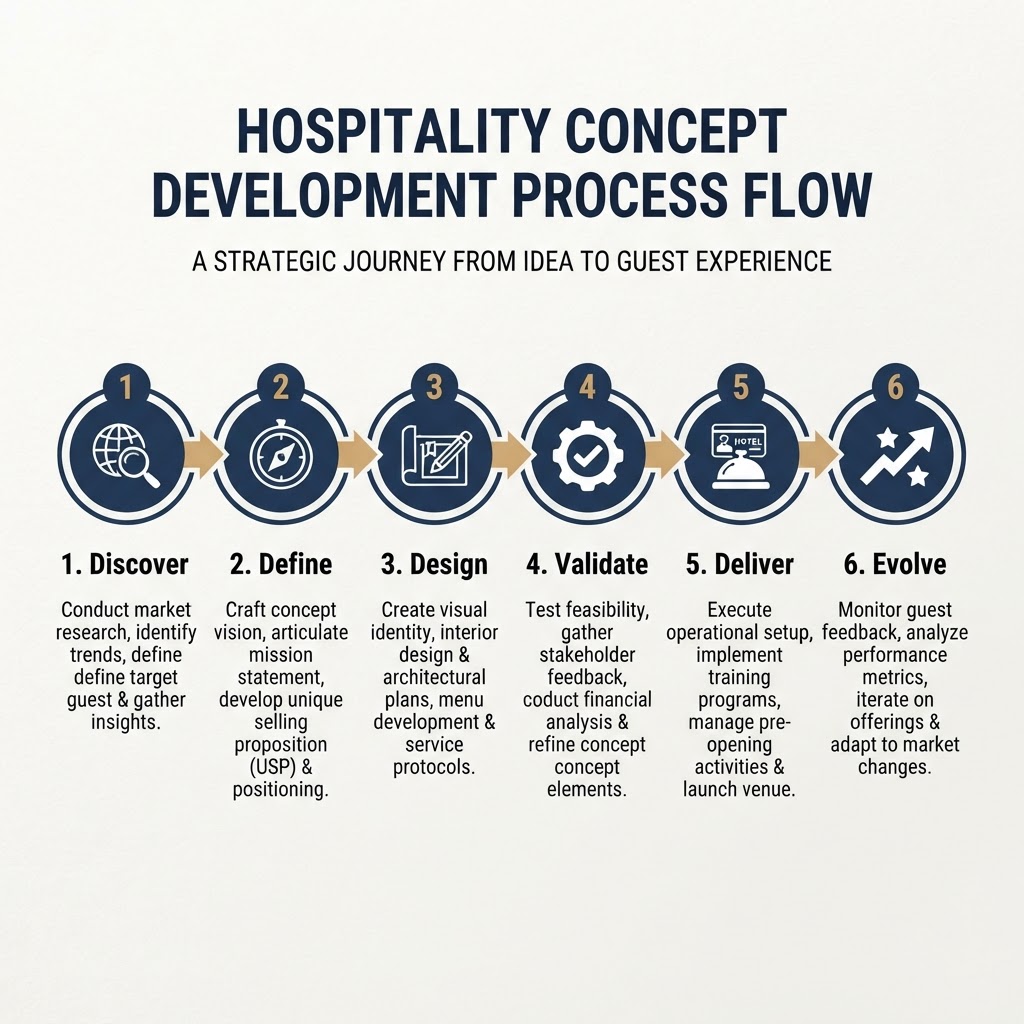 The TCA Method: Six-Stage Process
Stage 1: Discover — Understanding The Opportunity
Every project begins by resisting the temptation to solve the problem too quickly. Most hospitality projects begin with an idea — a cuisine, a format, a site. The Discover stage begins instead with questions.
Why this project? Why this location? Why now? Who is it really for? What opportunity exists that does not exist today?
The Discover stage immerses the project team in the market: demand analysis, competition mapping, consumer behaviour, cultural context, tourism patterns, commercial realities, and client ambitions. The goal is not to confirm the original idea but to test it — and to remain willing to challenge it completely.
The key tool is the Opportunity Assessment: a structured analysis that maps the market on dimensions that matter to guests (not just to operators), identifies white space using positioning matrices, tests demand through behavioural personas, and concludes with a Proceed, Refine, or Stop recommendation.
The most valuable output of this stage is often not the recommendation to proceed — it is the refinement of the original idea. Projects frequently enter the Discover stage with one concept in mind and emerge with a different, stronger one. The willingness to let the market reshape the idea is what separates strategic concept development from idea execution.
The willingness to recommend Stop is what makes the assessment credible. If the process can only produce 'yes', it is not an assessment — it is a rubber stamp. The most valuable feasibility work is sometimes the work that prevents a project from happening.
Illustrative example: Consider a Japanese dining concept entering a saturated market as 'another premium sushi restaurant'. An opportunity assessment that maps the market on visibility and format rather than cuisine quality can reveal that even a saturated sushi market has an empty quadrant: hidden, ritual-driven omakase. The concept that emerges is fundamentally different from the one that entered — and fundamentally more defensible. This is the kind of reframing the Discover stage is designed to produce.
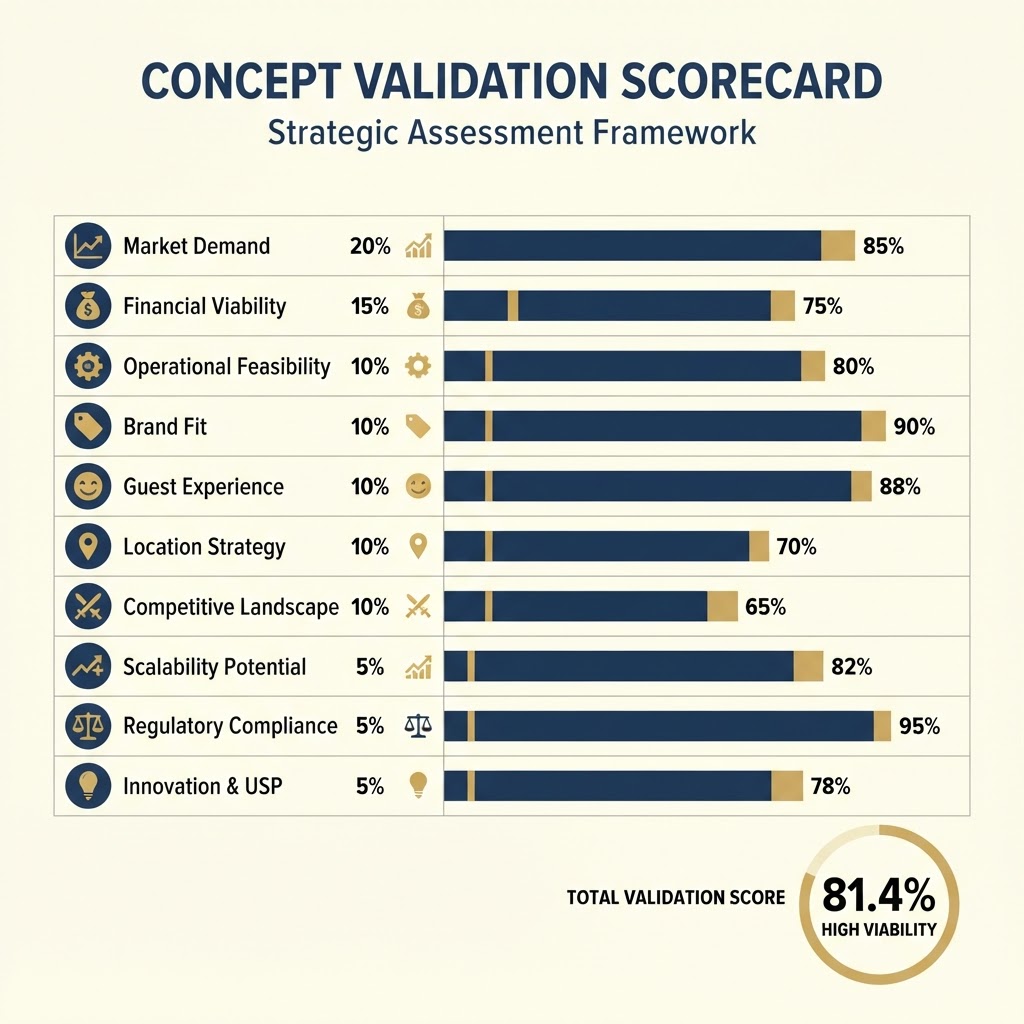 The Concept Validation Framework: 10 Weighted Dimensions
Decision gate: Does the opportunity assessment conclude Proceed or Refine? If Stop, the project does not advance.
Stage 2: Define — Establishing The Concept's Identity
Once the opportunity is understood, the Define stage shapes what the concept should become. This is where strategy takes form.
Who is the guest? What problem are we solving? How should this concept be positioned? What makes it distinctive? Why will people choose it instead of every other option available to them?
The Define stage produces three foundational documents:
Guest DNA: behavioural personas — not demographic segments — with specific motivations, behaviours, and first-person mindset quotes. Each persona should be detailed enough to predict how the guest will arrive, who they will be with, what they will order, what they will photograph, and what they will say the next day. The mindset quote — a single sentence in the guest's own voice — is the most powerful alignment tool in the process. One authentic sentence does more to align a creative team than paragraphs of demographic description.
Positioning Statement: a single, clear sentence that defines the concept's unique market position, tested against three questions: Is it true? Is it distinctive? Is it defensible? If the statement could apply to three competitors, it is not distinctive. If the unique attribute could be copied within a month, it is not defensible. Positioning is not what you say about yourself — it is what guests choose.
Concept Brief: the strategic document that translates all prior thinking into a brief that designers, operators, and stakeholders can act on. It is not a creative document — it is a strategic document that gives creatives the freedom to be creative within boundaries that protect the concept's commercial integrity. The brief specifies what is locked (the strategic decisions that cannot be changed) and what is open (the creative decisions that the design team is free to explore).
When this stage is complete, everyone involved should be able to describe the concept in a few clear sentences. If they cannot, the concept is not ready to move forward.
Real-world example: For INDIKAYA, a modern Indian dining concept in Dubai, TCA defined five guest personas, each with a mindset quote. 'I'm not here for butter chicken. I want to know the story behind the turmeric leaf.' That single sentence told the chef what to cook, the designer what atmosphere to create, and the marketer what story to tell — for that specific persona. Five sentences aligned the entire team.
Decision gate: Can every stakeholder describe the concept in a few clear sentences? Can the positioning statement pass the true/distinctive/defensible test? If no, the definition is not complete.
Stage 3: Design — Translating Strategy Into Experience
Only now does the project begin translating strategy into experience. Design, in this methodology, is much broader than architecture or interiors. It includes the guest journey, the arrival, the service philosophy, the menu architecture, the atmosphere, the operational flow, the commercial model, and the digital experience.
Every touchpoint should reinforce the same strategic idea. The question throughout is: does this decision strengthen the concept, or simply make it look better? Those are very different things.
The key tools are Experience Mapping (designing the guest journey as a narrative with pacing, tension, and release — not as a touchpoint list) and Community Anchoring (ensuring the concept belongs to its location, not just sits in it). The Experience Map specifies what the guest should feel at each moment — not just what they should see. The designer receives an emotional blueprint, not just a floor plan.
This stage also defines the brand's visual and verbal identity — but always in service of the strategic positioning, not as a separate exercise. The brand voice, the photography style, the signature rituals, and the FOH language system are all designed here, aligned with the personas and positioning defined in Stage 2.
Great design expresses strategy. It should never replace it. When the design starts driving the strategy rather than expressing it, the concept has lost its foundation.
Illustrative example: Consider a cliffside wellness village designed using a three-act narrative structure. Each of the six physical zones is mapped to an emotional purpose within the arc — departure, tension, release, integration, perspective. The design briefs specify lighting mood, material palette, acoustic target, scent, and temperature per zone — translating the emotional narrative into instructions the architect can execute. The result is a wellness destination where the architecture is the experience.
Decision gate: Does every design decision trace back to a strategic decision in Stages 1-2? Are the experience map and brand identity aligned with the positioning and personas? If design decisions cannot be traced to strategy, they are decoration.
Stage 4: Validate — Challenging The Concept Against Reality
This is where optimism meets reality. The concept is challenged from every angle: Can it operate efficiently? Can it generate sustainable revenue? Does the business model support the guest experience? Have we overlooked operational complexity? Can the concept grow beyond opening day?
The Concept Validation Framework evaluates the concept across ten dimensions: Market Opportunity, Guest Relevance, Strategic Differentiation, Brand Coherence, Guest Experience, Operational Feasibility, Commercial Viability, Place & Community Fit, Future Readiness, and Investment Confidence.
Four dimensions — Market Opportunity, Strategic Differentiation, Operational Feasibility, and Commercial Viability — are hard gates. A score below acceptable in any of these pauses the project. Beautiful design cannot compensate for a weak business case.
The validation is not a financial model. It is a structured assessment that scores each dimension, identifies weaknesses while they are still inexpensive to solve, and produces a clear recommendation: proceed, refine, or stop and address the gaps.
The most valuable validations are the ones that identify a problem the team had not seen. A concept that passes every dimension without challenge was either perfectly designed (rare) or the validation was not rigorous enough (common). The value of validation is in what it catches, not in what it approves.
Illustrative example: Consider a hospitality product company validating an entirely new product category using a structured study organised around six sequential questions — mirroring what a senior stakeholder would actually ask before committing capital. The study identifies white space structurally through a competitive positioning map, triangulates pricing from two independent benchmarks, and uses sequential gates (not weighted scores) for pilot site selection. The result is typically a 'Go — but with discipline' recommendation with a specific seven-move action plan.
Decision gate: Do all hard gates pass? Are soft dimensions scored above acceptable? If hard gates fail, the project pauses and the gaps are addressed before proceeding.
Stage 5: Deliver — Turning Strategy Into Reality
Once the concept has been validated, it must be translated into something others can build. Strategy becomes documentation. Ideas become decisions. The concept becomes a blueprint.
This stage aligns operators, designers, consultants, brand partners, and stakeholders around one shared vision. The Implementation Roadmap documents every decision made during the prior stages, creates role-specific alignment packs (the architect receives different documentation than the kitchen consultant, who receives different documentation than the marketing team), defines what is locked versus what can be refined during build-out, and establishes quality review checkpoints.
The most common failure in delivery is drift. Each consultant, contractor, and supplier makes small adjustments to accommodate their constraints. Each adjustment seems reasonable in isolation. Together, they produce a built reality that does not match the designed concept. The Implementation Roadmap prevents drift by giving every party the same reference point — and by establishing checkpoints where the built reality is compared against the strategic intent.
Good delivery is not about producing beautiful presentations. It is about ensuring every person involved understands not only what they are building, but why they are building it. Consistency comes from clarity.
Real-world example: Alley Cats Pizza, a New York-style pizza concept entering the UAE market, used a Brand DNA Protection Framework as the core delivery document. The framework explicitly defined what must never change (product, price, brand story) and what could flex (operations, staffing, marketing channels). When localisation pressure came during delivery — requests for menu changes, family bundles, permanent discounting — each request was evaluated against the framework, not debated as a novel proposition. The framework prevented the drift that destroys most international expansions.
Decision gate: Is every stakeholder aligned on what is locked and what is open? Are quality review checkpoints in place? If alignment is unclear, delivery will drift.
Stage 6: Evolve — Growing Without Losing Identity
Opening day is not the finish line. It is the beginning of the concept's real life. Hospitality is constantly changing — markets evolve, guests evolve, cities evolve, technology evolves. A concept that does not evolve will eventually be overtaken. But a concept that evolves without discipline will lose the identity that made it successful.
The Evolve stage uses two key tools:
The Concept & Experience Review is a diagnostic for existing venues. It starts with the Identity Test: can the business complete the sentence 'known for ___' in a way that customers would recognise? If the answer is generic — 'a nice place', 'convenient' — the venue has a location, not an identity. The review then examines dayparts, menu, service, space, and programming to identify where the biggest commercial opportunities are hidden behind the veneer of being 'busy'.
The Concept DNA Protection Framework defines what must never change versus what can flex. It is the same tool used in delivery (Stage 5) — but applied to an operating concept rather than a new one. As the concept grows, expands to new markets, or adapts to changing conditions, the framework ensures that the core identity is preserved while the operational layer adapts.
A successful hospitality concept is never static. It is a living business that grows without losing its identity. The Evolve stage is not an afterthought — it is the stage that determines whether the concept will last for three years or thirty.
Illustrative example: Consider a neighbourhood café and bar that is commercially successful but strategically undifferentiated — busy but not known for anything specific. The Concept & Experience Review diagnoses the gap and prescribes targeted interventions: daypart-driven menu engineering, signature cocktails, weekly evening activations, terrace zoning, and a daily special. Each intervention has an investment, a projected ROI, and a test period. The venue gains a strategic identity without losing the commercial logic that made it successful.
Decision gate: Is there a process for regular review? Is the DNA protection framework documented? If no, the concept will drift aimlessly over time.
The Commercial Discipline
Hospitality is emotional. But hospitality businesses survive through commercial discipline. A concept that cannot sustain itself financially cannot continue creating meaningful guest experiences.
Commercial thinking is often misunderstood as compromising creativity. The opposite is true. Commercial thinking protects creativity. It ensures that great ideas can continue to exist. Revenue enables reinvestment. Profit funds innovation. Operational efficiency creates consistency. Commercial success allows hospitality to remain generous.
The commercial dimensions that matter most:
Unit economics. Does the concept's price point, cost structure, and cover volume produce a sustainable margin? A concept that cannot cover its costs at the expected sales level is not commercially viable — regardless of how good the experience is.
Daypart utilisation. A space that generates revenue for three hours a day is paying rent for twenty-one. Concepts that can activate multiple dayparts — or that use a dual-identity model to serve different audiences at different times — have fundamentally better economics.
Revenue diversification. A concept that depends on one revenue stream (dine-in covers) is more fragile than one that layers multiple streams (dine-in, delivery, retail, events, memberships). Each additional stream adds resilience.
Operational feasibility. Can the concept be operated by the team available, at the cost available, in the market available? The most beautiful concept that cannot be staffed is not a concept — it is a rendering.
The objective is not to maximise revenue at the expense of experience. Nor is it to maximise experience while ignoring economics. The objective is to create concepts where commercial performance and guest value strengthen one another. That balance is where enduring hospitality brands are built.
Common Pitfalls
-
Skipping stages. The most common mistake is jumping to Design (Stage 3) without completing Discover and Define. This produces a concept that looks good but has no strategic logic — and no defense against competitors who did the foundational work.
-
Treating validation as a formality. If the validation stage cannot produce a 'Stop' or 'Refine' recommendation, it is not validation — it is confirmation bias. The value of validation is in what it catches, not what it approves.
-
Confusing positioning with a tagline. A tagline is what you say. Positioning is what guests choose. If the positioning does not change guest behaviour, it is copywriting, not strategy.
-
Designing for everyone. A concept designed for everyone appeals to no one distinctly. Specificity is not a limitation — it is a competitive advantage.
-
Ignoring the post-launch phase. A concept that is brilliant at launch but has no evolution plan will degrade over time. The Evolve stage is not optional — it is what determines whether the concept lasts.
The Principle
Great hospitality is not designed from the inside out. It is understood from the outside in. The market comes before the menu. The guest comes before the building. Strategy comes before aesthetics. Because when the thinking is right, every creative decision has a purpose.
This guide is adapted from The Concept Artisan's TCA Method, a structured approach to hospitality concept development developed through real project work across the Middle East and Europe. The complete methodology is used in consulting engagements. Selected frameworks are published in the Hospitality Intelligence Library.
For more articles, frameworks, and case studies, explore the Hospitality Intelligence Library.