Hotel F&B positioning and commercial strategy: how to turn hotel restaurants from amenity to advantage. Operator models, revenue strategy and guest experience design.
STRATEGIC GUIDE: HOTEL F&B POSITIONING AND COMMERCIAL STRATEGY
How to Turn Hotel F&B from a Cost Centre into a Brand Asset
Most hotel F&B is an afterthought. The rooms are the product; the restaurant is the amenity. The menu is designed to satisfy guests who don't want to leave the hotel. The pricing is set to match the room rate. The design is coordinated with the lobby. The result is F&B that is competent, unremarkable, and invisible to non-residents — a cost centre that is tolerated rather than valued.
Exceptional hotel F&B is different. It is designed as a destination in its own right — with its own brand, its own audience, and its own commercial targets. It attracts non-residents who would never visit a hotel restaurant but who will visit a destination restaurant that happens to be in a hotel. It generates revenue that exceeds the hotel's per-square-metre average. It elevates the hotel's brand profile. It is an asset, not an amenity.
This guide defines the strategic framework for positioning hotel F&B as a brand and commercial asset — not a service obligation.
PART 1: THE STRUCTURAL PROBLEM WITH HOTEL F&B
Hotel F&B faces three structural challenges that standalone restaurants do not:
Challenge 1: The hotel brand constrains the restaurant's positioning. Guests assume the restaurant's quality matches the hotel's star rating. A four-star hotel restaurant is assumed to be four-star — regardless of the food. This constraint means the restaurant must either match the hotel's positioning (limiting its creative range) or break free of it (requiring a separate brand identity).
Challenge 2: The captive audience masks the real performance. Hotel restaurants serve breakfast to hotel guests, lunch to business travellers, and dinner to guests who don't want to venture out. This captive revenue creates the illusion of success — the restaurant is busy, so it must be good. But the captive revenue masks the real question: would anyone who is not staying in the hotel choose to eat here?
Challenge 3: The operational structure is hotel-optimised, not restaurant-optimised. Hotel F&B is typically managed by the hotel's F&B Director, who also manages room service, banqueting, and the bar. The restaurant does not have an autonomous operator with the autonomy, incentive, and expertise to build a standalone brand.
These challenges are structural — they cannot be solved by better food or better service alone. They require a strategic repositioning of the F&B within the hotel's business model.
PART 2: THREE STRATEGIC POSITIONS FOR HOTEL F&B
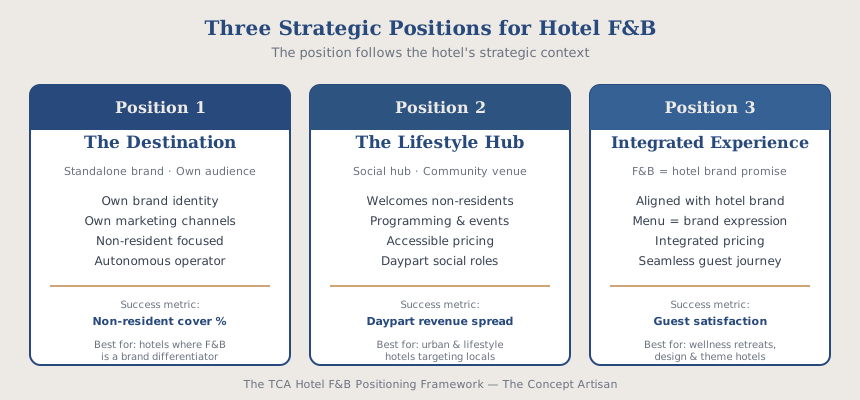 The three strategic positions for hotel F&B
Position 1: The Destination Restaurant The F&B is positioned as a standalone destination concept with its own brand identity, its own audience, and its own marketing. The hotel is the location, not the brand. The restaurant has a distinct name, a distinct design language, and a distinct positioning that is independent of the hotel. This position requires: a concept that could succeed as a standalone restaurant, a marketing strategy that targets non-residents, and an operational structure that gives the restaurant autonomy from the hotel's F&B department. Commercial model: The restaurant generates revenue from both residents and non-residents. Non-resident revenue is the measure of success — it proves the concept is a destination, not an amenity.
Position 2: The Lifestyle Hub The F&B is positioned as a social hub that serves both hotel guests and the local community. It is not a standalone destination, but it is also not just a hotel restaurant. It is the place where the hotel's public spaces become a social venue — a lobby bar that doubles as a co-working space by day and a cocktail bar by night, a restaurant that serves as the neighbourhood's living room. This position requires: a design that welcomes non-residents without making them feel like they are entering a hotel, a programming strategy that creates reasons to visit (live music, talks, events), and a pricing strategy that is accessible to the local community. Commercial model: The F&B generates revenue across dayparts, with the daytime revenue driven by the local community and the evening revenue driven by both residents and non-residents.
Position 3: The Integrated Experience The F&B is positioned as an integral part of the hotel's brand promise — not independent of it, but a core expression of it. This is the model of wellness retreats where the cuisine is part of the wellness programme, or design hotels where the restaurant is part of the design story. The F&B and the hotel are one experience. This position requires: a concept that is fully aligned with the hotel's positioning, a menu and service style that express the hotel's brand values, and a pricing structure that is integrated with the room rate (e.g. half-board or full-board options). Commercial model: The F&B revenue is captured within the room rate or as a mandatory add-on. The measure of success is guest satisfaction, not non-resident covers.
The critical decision is choosing the position that matches the hotel's strategic context — not the position that sounds most ambitious. A suburban business hotel cannot sustain a Destination Restaurant. A luxury resort should not settle for a Lifestyle Hub. The position follows the strategy.
PART 3: THE WHITE-LABEL DECISION
If Position 1 (Destination Restaurant) is chosen, the next decision is whether to develop the concept in-house (bespoke) or bring in a third-party operator (white-label).
Bespoke (in-house development):
- Full brand equity and control
- Full revenue retention
- Development cost and operational responsibility
- Requires restaurant development expertise within the hotel team
- Best when: the hotel has F&B development capability and wants to build a proprietary brand
Third-party operator:
- Established brand and audience from day one
- Operational expertise and restaurant marketing capability
- Revenue share or lease structure (lower total revenue but lower risk)
- Less control over brand standards and guest experience alignment
- Best when: the hotel lacks restaurant development capability or wants to reduce operational risk
The decision should be made per outlet, not for the entire hotel. The destination restaurant may be third-party, the bar may be bespoke, and the breakfast may be self-operated. Each outlet's strategic role determines the right operating model.
PART 4: THE COMMERCIAL MODEL
Hotel F&B has a distinct commercial structure that differs from standalone restaurants in three ways:
-
Revenue capture from captive audience: Hotel guests provide a baseline of F&B revenue through breakfast, room service, and convenience dining. This captive revenue covers a portion of fixed costs, which means the marginal revenue from non-resident covers falls more directly to profit.
-
Cross-selling between rooms and F&B: A destination restaurant attracts non-residents who may become future hotel guests. A bar that is popular with locals creates profile for the hotel. The F&B is not just a revenue stream — it is a marketing channel for the rooms business.
-
Daypart optimisation: Hotel F&B has the opportunity to operate across more dayparts than a standalone restaurant — breakfast (captive), lunch (mixed), dinner (destination), late night (bar). Each daypart should be priced and programmed for its specific audience and revenue potential.
The commercial target should be defined per outlet and per daypart:
- Breakfast: measured by guest satisfaction and revenue per occupied room
- Lunch: measured by non-resident covers and average check
- Dinner: measured by non-resident percentage and revenue per square metre
- Bar: measured by revenue per seat and dwell time
PART 5: COMMON STRATEGIC MISTAKES
Mistake 1: Designing the F&B to match the lobby. The restaurant is not an extension of the lobby. It should have its own design language, its own atmosphere, and its own identity. A restaurant that looks like a hotel lobby feels like a hotel restaurant — which is exactly what non-residents avoid.
Mistake 2: Pricing to match the room rate. Hotel restaurants often price at a premium because hotel guests are less price-sensitive. This works for captive revenue but repels non-residents. If the goal is to attract non-residents, the pricing must be competitive with standalone restaurants of comparable quality.
Mistake 3: Marketing the F&B through hotel channels only. Hotel marketing channels (OTA, corporate accounts, loyalty programmes) do not reach restaurant customers. The F&B needs restaurant marketing — food media, social media, local PR, and community engagement. If the hotel's marketing team cannot provide this, the F&B needs its own marketing plan.
Mistake 4: Treating non-residents as intruders. Non-resident visitors to a hotel restaurant often face friction: navigating the lobby, past reception, through corridors. The access should feel like arriving at a destination, not infiltrating a hotel. If the entrance is friction-heavy, non-residents will not return.
Mistake 5: One operator for all outlets. Hotel F&B Directors manage multiple outlets, which means no outlet gets the focused attention it needs. The destination restaurant needs a dedicated operator. The bar needs a dedicated bar manager. The breakfast needs operational efficiency, not creative leadership. Bundling them under one manager ensures none reaches its potential.
Mistake 6: No performance measurement beyond revenue. Revenue is a lagging indicator. The leading indicators of hotel F&B health are: non-resident cover percentage, return visit rate, review scores, and social media sentiment. If these are not tracked, the F&B's real performance is invisible until revenue declines.
PART 6: THE ASSESSMENT FRAMEWORK
If you are evaluating your hotel's F&B, assess it against seven questions:
- Does the F&B have its own brand identity, or is it 'The Restaurant at [Hotel]'?
- What percentage of covers are non-residents? (Below 30% suggests the F&B is an amenity, not a destination)
- Would a non-resident choose this restaurant over a standalone restaurant of comparable quality?
- Is the F&B marketed through restaurant channels, or only through hotel channels?
- Does the F&B have a dedicated operator, or is it managed by the hotel's F&B Director alongside other outlets?
- Is the pricing competitive with standalone restaurants, or premium-loaded by the hotel rate?
- Is the F&B performance measured by leading indicators (non-resident covers, return visits, sentiment) or only by revenue?
If the answers reveal an amenity, not an asset, the F&B is underperforming its strategic potential. The fix is not better food — it is a strategic repositioning that gives the F&B its own identity, its own audience, and its own commercial targets.
THE PRINCIPLE
Hotel F&B is not a service obligation. It is a commercial and brand opportunity that most hotels fail to capture. The hotels that succeed are the ones that treat their F&B as a destination — with its own brand, its own audience, and its own strategic positioning. The rooms provide the baseline. The F&B provides the profile.
This guide is based on TCA's framework for hotel F&B strategy, developed through concept development and market validation work across the Middle East and Europe. For a tailored assessment of your hotel's F&B positioning, contact The Concept Artisan.