
Every Hospitality Project Begins With An Idea. A Chef Has A Concept. A Developer Sees A Site. A Hotel Wants A New Restaurant. An Investor Wants The Next Big Thing.

FRAMEWORK: OPPORTUNITY ASSESSMENT — SHOULD THIS CONCEPT EXIST AT ALL?
The Most Important Question
Every hospitality project begins with an idea. A chef has a concept. A developer sees a site. A hotel wants a new restaurant. An investor wants the next big thing.
Before any of these ideas proceed to design, branding, or investment, one question must be answered — and it is the question most frequently skipped in hospitality development:
Should this concept exist at all?
The Opportunity Assessment is the framework that answers this question. It is not a market research report. It is a decision-making instrument designed to reduce uncertainty before money is committed.
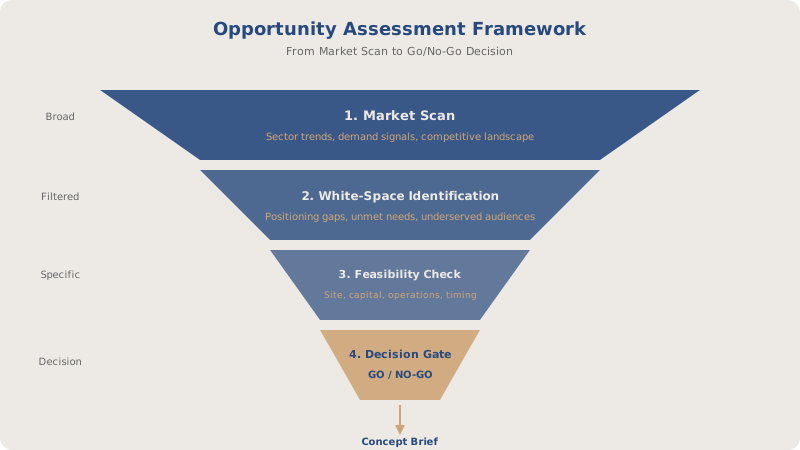 Opportunity Assessment Framework: From Market Scan to Go/No-Go Decision
When To Use It
At the very start of a project — before briefs are written, before designers are briefed, before budgets are allocated. Everything that follows depends on its conclusions.
The Process
Step 1: Map The Category Structure
Don't just list competitors. Break the market into segments by product type, format, price band, and audience. The goal is to understand the structure of the market, not just its size.
Step 2: Identify White Space
Use a 2x2 positioning matrix to find the gap no competitor occupies. Map competitors on two dimensions that matter to guests — not to operators. Visibility, accessibility, format, ritual, and social function often reveal more useful gaps than cuisine or price.
Step 3: Test Demand
Define 3-5 guest segments using behavioural data — not just demographics. Who are they, what do they value, how often do they visit, what do they spend, and what is missing from their current options?
Step 4: Assess Commercial Attractiveness
Is the market growing or shrinking? Are margins sustainable? Is the competitive intensity manageable? Is there a realistic path to profitability?
Step 5: Conclude
The output is never a flat yes or no. It is one of three recommendations:
- Proceed — the opportunity is real and defensible.
- Refine — the opportunity exists but the original idea needs adjustment.
- Stop — the market does not support the concept as conceived.
The Three Most Common Mistakes
-
Treating market size as validation. A large market with no white space is harder to enter than a small market with a clear gap. Market size tells you how big the pie is. It does not tell you whether there is a slice for you.
-
Mapping competitors by cuisine type only. Two restaurants serving the same cuisine may be in completely different businesses — different format, different audience, different social function. The real differentiators are often format, accessibility, and social function.
-
Skipping the 'Stop' option. If your assessment can only produce 'yes', it is not an assessment. It is a rubber stamp. The willingness to recommend 'Stop' is what makes the assessment credible.
The Output
An Opportunity Brief containing: market structure analysis, a white-space map, guest demand assessment, a competitive intensity score, and a Proceed/Refine/Stop recommendation with named conditions for success.
The Principle
The most expensive decision in hospitality is the one made before the question has been properly asked. The Opportunity Assessment exists to make sure that decision is never made lightly.
This framework is adapted from The Concept Artisan's TCA Method and is used in consulting engagements across the Middle East and Europe.