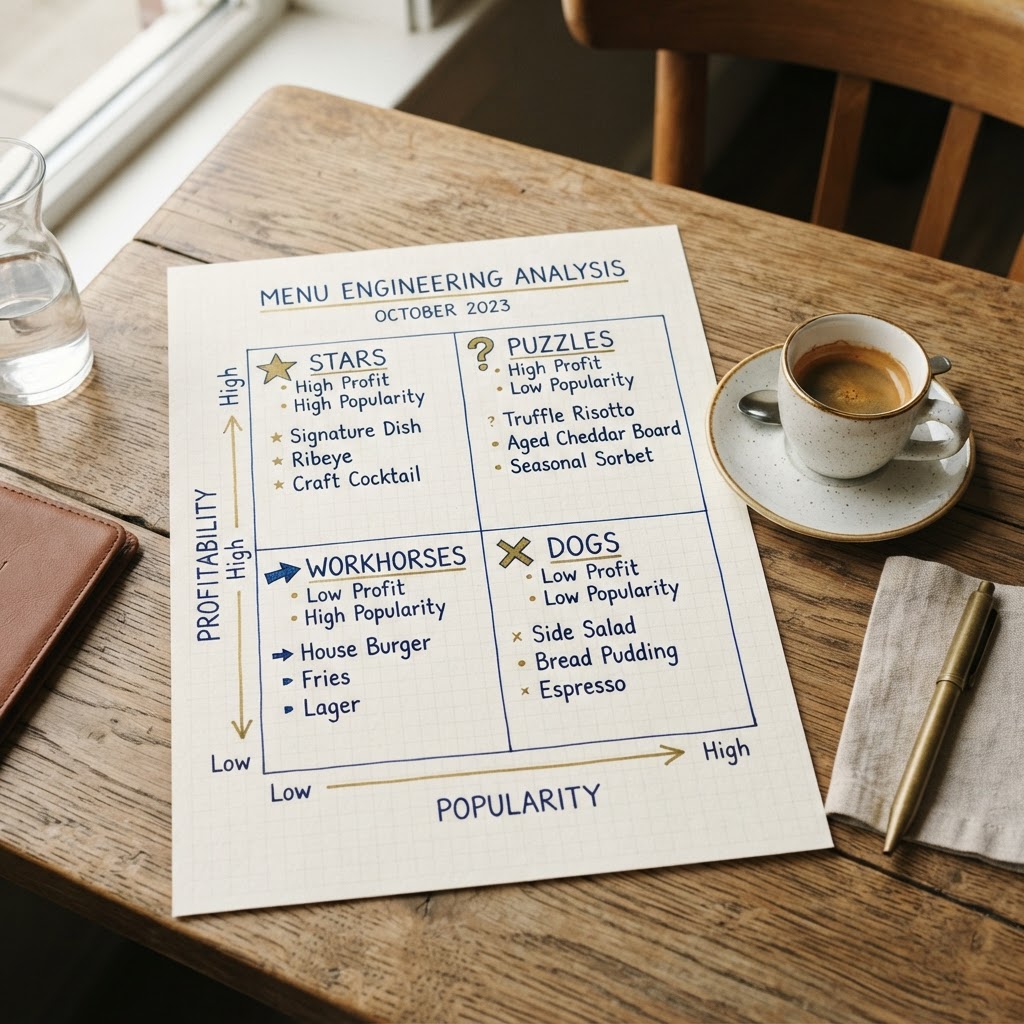
Menu Engineering Is The Strategic Design Of A Restaurant Menu — Not The Recipes, But The Structure: What Items Appear, Where They Appear, How They Are Priced, And How The Menu Architecture Reinforces The Concept's Positioning.

MENU ENGINEERING AND ARCHITECTURE
Definition
Menu engineering is the strategic design of a restaurant menu — not the recipes, but the structure: what items appear, where they appear, how they are priced, and how the menu architecture reinforces the concept's positioning.
A menu is not a list of dishes. It is the single most important commercial document in a restaurant. Every item on it is a decision about what the concept stands for, who it serves, and how it makes money.
Why It Matters
A well-engineered menu does three things simultaneously: it communicates the concept's identity (what makes this place different), it guides guest behaviour toward profitable items, and it creates a pricing structure that supports the business model.
A poorly engineered menu does the opposite: it confuses guests, dilutes the concept's identity with irrelevant items, and sells mostly low-margin dishes because they happen to be the most accessible.
How To Think About It
Menu engineering operates on four levels:
-
Structure: the categories, the number of items per category, and the logical flow of the menu. A menu with 40 items tells a different story than a menu with 12.
-
Signature items: 3-5 dishes that define the concept's food identity. These are the items that guests remember, recommend, and return for. They must never be removed — they are the menu's anchor.
-
Pricing logic: not just the prices, but the relationship between prices. The spread between the cheapest and most expensive item signals positioning. A menu where everything costs the same has no positioning.
-
Menu-to-positioning link: every item should reinforce the concept's strategic position. If the concept is positioned as 'casual fine dining', a generic burger on the menu weakens the positioning — even if it sells well.
Real-World Example
In the 22 Omakase project, the menu was not a menu at all — it was an omakase course sequence. The 'engineering' was in the pacing: each course built on the previous one, creating a narrative arc from light to rich to surprising to satisfying. The menu's structure WAS the experience. Removing or reordering a course would break the narrative.
Related Concepts
Daypart Strategy, Concept Positioning, Pricing Strategy in Hospitality