Placemaking Through F&b Is The Strategic Use Of Food And Beverage Concepts As The Primary Mechanism For Creating Identity, Footfall, And Emotional Connection In A Physical Space — Whether A Mixed-use Development, A Neighbourhood, A Hotel, Or A Public Realm.
PLACEMAKING THROUGH F&B
Definition
Placemaking through F&B is the strategic use of food and beverage concepts as the primary mechanism for creating identity, footfall, and emotional connection in a physical space — whether a mixed-use development, a neighbourhood, a hotel, or a public realm.
The principle is simple: people go where there is food and drink. If you want a space to feel alive, to attract people, and to develop a character that cannot be replicated, F&B is the most effective tool available. Not retail (which is increasingly digital), not offices (which generate limited public activity), not residential (which is private). F&B is the public-facing, experience-driven, footfall-generating anchor that makes a place a destination.
Why It Matters
Developments that treat F&B as a service amenity — something to fill ground-floor units and generate rent — miss the strategic opportunity. F&B is not a tenant category. It is a placemaking tool. The right F&B concepts, in the right locations, with the right curation, can define the identity of an entire development.
A mixed-use development with generic chain restaurants feels like every other development. A mixed-use development with a curated mix of distinctive F&B concepts — a destination restaurant, a neighbourhood café, a specialty bar, a food hall — feels like a place with character. That character is what drives footfall, dwell time, and ultimately the commercial performance of every other component in the development.
How To Think About It
-
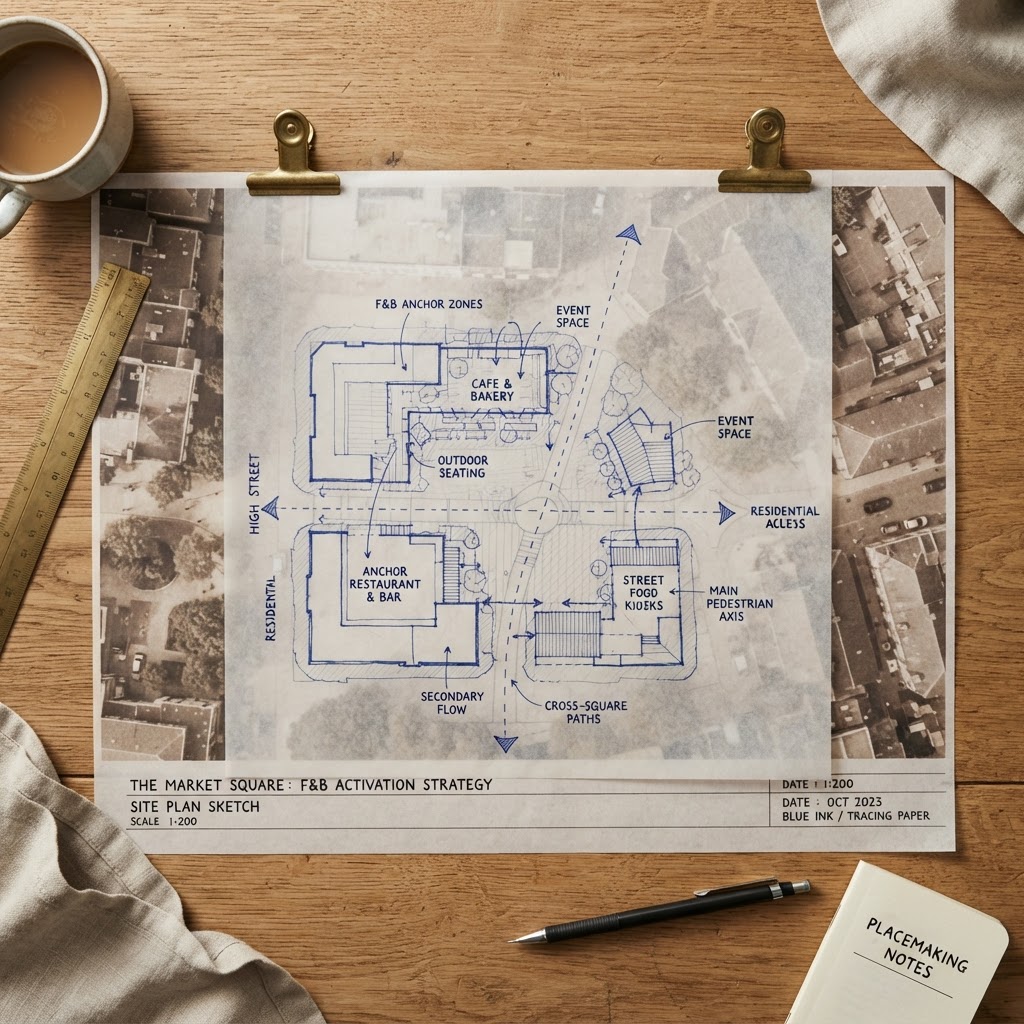
Anchor first: Identify the F&B anchor — the destination concept that will draw traffic to the development. This is usually a signature restaurant or a food hall, not a café or a quick-service outlet.
-
Layer around the anchor: Add F&B concepts that complement the anchor and extend the dayparts — a café for morning traffic, a bar for evening energy, a casual option for lunch.
-
Design the public realm: The spaces between F&B outlets — the plaza, the walkway, the terrace — are where placemaking actually happens. These spaces should be designed for lingering, not just for transit.
-
Programme the space: Consistent events, activations, and seasonal programming keep the space alive between meals. F&B provides the infrastructure; programming provides the rhythm.
Real-World Example
In the Al Jazira Stadium project, F&B was used as a placemaking tool across multiple zones — premium dining, casual F&B, and general admission concessions. Each zone's F&B was designed to create a different atmosphere and attract a different audience, transforming the stadium from a functional venue into a multi-experience destination.
Related Concepts
Mixed-Use Hospitality Real Estate Positioning, Destination F&B, Food Hall Strategy