
Most Hospitality Reviews Focus On Execution: Was The Food Hot, Was The Service Fast, Was The Room Clean. These Are Important Questions. But They Measure How Well The Venue Is Doing What It Does — Not Whether What It Is Doing Is The Right Thing.

FRAMEWORK: CONCEPT REVIEW — A STRATEGIC DIAGNOSTIC FOR EXISTING VENUES
The Problem With Most Hospitality Reviews
Most hospitality reviews focus on execution: was the food hot, was the service fast, was the room clean. These are important questions. But they measure how well the venue is doing what it does — not whether what it is doing is the right thing.
A strategic concept review asks a different question: is this venue operating at its strategic potential? A venue can execute perfectly and still be strategically invisible — busy but not distinctive, profitable but not defensible. The concept review is designed to reveal that gap before it becomes a problem.
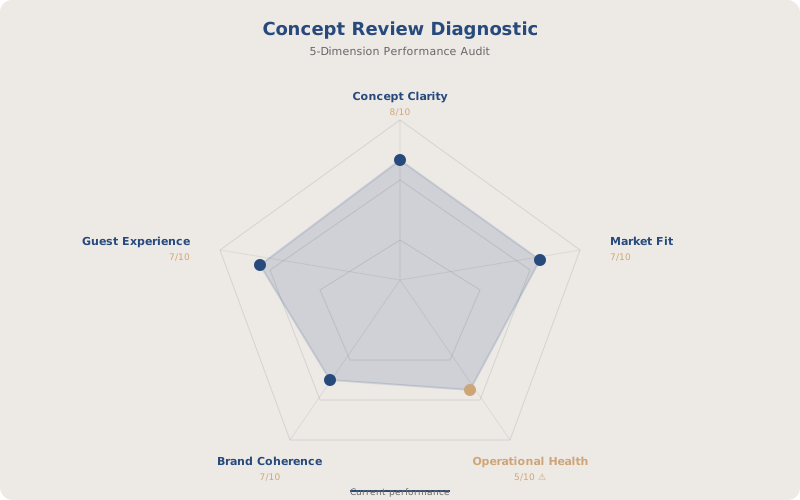 Concept Review Diagnostic: 5-Dimension Performance Audit
When To Use It
For any existing hospitality venue that is commercially successful but strategically unclear — busy but not known for anything specific. Also for venues that are performing adequately but sense they have untapped potential, or for venues facing new competition that threatens their position.
The Process
Step 1: The Identity Test
The fastest diagnostic tool in hospitality. Ask: can the business complete the sentence 'known for ___' in a way that customers would recognise?
Test it with real customers, not the owner. If customers say 'a nice place' or 'convenient', the venue has a location, not an identity. If they say 'the best wood-fired sourdough in the neighbourhood' or 'the Thursday live jazz', the venue has an identity.
The test works because it forces specificity. Generic answers fail. Specific, verifiable, defensible answers pass. The gap between the owner's answer and the customer's answer is the starting point for strategic improvement.
Step 2: The Gap Diagnosis
Compare the venue's commercial logic (what makes it profitable) with its strategic identity (what makes it distinctive). Where do they align? Where do they conflict?
A venue whose commercial logic is 'all-day, broad menu, serves everyone' and whose strategic identity is 'known for nothing specific' has a clear gap: the commercial strength (breadth) is the strategic weakness (lack of focus). The prescription is not to abandon the commercial logic but to build a strategic identity on top of it.
Step 3: The Guest Experience Review
Evaluate the experience during peak and off-peak periods separately. This separation matters: service quality often degrades during peak periods, and the gap between the guest experience at 2pm and 8pm can reveal where the venue is leaving the most opportunity on the table.
Review: menu structure, bar programme, terrace utilisation, programming, service pace, atmosphere consistency, and daypart transitions. Look for areas that are functional but not distinctive — places where the venue is competent but not memorable.
Step 4: The Strategic Prescription
Produce a set of targeted interventions, each with:
- The intervention — what specifically is recommended
- The investment — how much it will cost
- The projected ROI — conservative, not optimistic
- The test period — how long before results are evaluated
- The KPI — what metric determines success
The prescription should be specific, measurable, and prioritised by ROI. Recommendations without metrics are opinions. Recommendations with ROI and KPIs are business decisions.
The Three Most Common Mistakes
-
Reviewing execution instead of strategy. A mystery guest report tells you whether the service was good. A concept review tells you whether the venue has a reason to exist beyond its location. Both are valuable. They are not the same.
-
Ignoring the gap between owner and customer perception. If the owner says 'known for our innovative menu' but customers say 'known for being open late', the venue's real identity is not what the owner thinks. That gap is the diagnosis.
-
Prescribing without ROI. A recommendation that cannot be measured cannot be evaluated. Without evaluation, there is no way to know whether the intervention worked — and no basis for refining the strategy.
The Principle
The most valuable strategic work is often not creating something new — it is revealing what an existing business could become. The ingredients are usually already there. The concept review makes them visible.
This framework is adapted from The Concept Artisan's TCA Method and is used in consulting engagements across the Middle East and Europe.