Hotel F&b Is One Of The Most Debated Topics In Hospitality Strategy. For Decades, Hotel F&b Was An Afterthought — A Mandatory Service That Guests Expected But Rarely Celebrated. Hotels Operated Their Restaurants And Bars Because That Was What Hotels Did, Not Because The F&b Was Commercially Or Strategically Valuable.

DECISION GUIDE: SHOULD OUR HOTEL OUTSOURCE F&B OR SELF-OPERATE?
The Question
Hotel F&B is one of the most debated topics in hospitality strategy. For decades, hotel F&B was an afterthought — a mandatory service that guests expected but rarely celebrated. Hotels operated their restaurants and bars because that was what hotels did, not because the F&B was commercially or strategically valuable.
That has changed. Today, hotel F&B can be a profit centre, a brand differentiator, and a driver of both occupancy and non-resident revenue. But the question remains: should you operate it yourself, or outsource it to a specialist operator?
This is not a binary choice. It is a strategic decision that depends on the hotel's positioning, its target guest, its competitive context, and its internal capabilities.
When Self-Operation Makes Sense
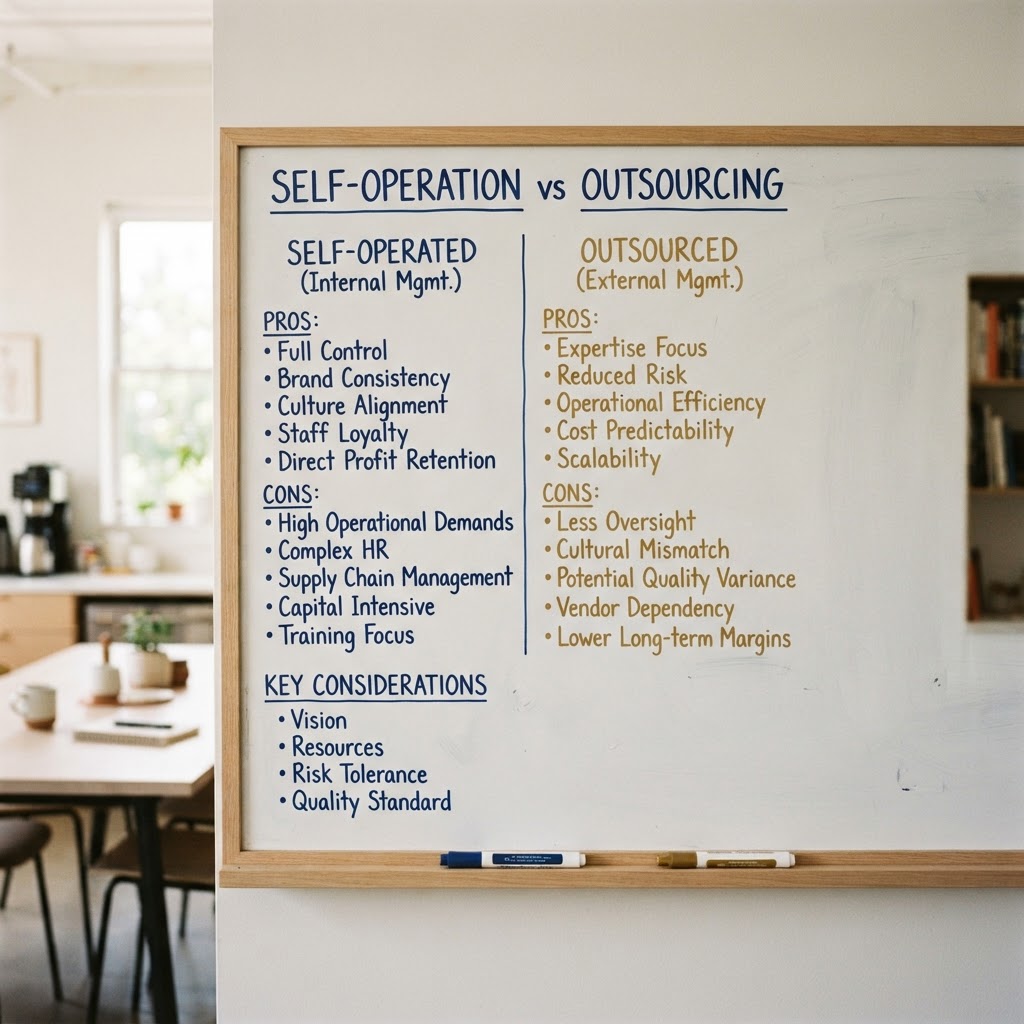
Self-operation makes sense when F&B is a core part of the hotel's brand promise.
If the hotel is positioned as a culinary destination — where guests choose the hotel partly because of the food and beverage experience — then outsourcing the F&B means outsourcing the brand. The operator's brand becomes the hotel's brand, and the hotel loses direct control over one of its primary differentiators.
Self-operation also makes sense when the hotel has or can build F&B expertise. Running great hotel restaurants requires a specific skill set: menu development, service standards, wine programmes, event catering, and room service integration. If the hotel team has these capabilities, self-operation retains full revenue and full control.
When Outsourcing Makes Sense
Outsourcing makes sense when F&B is a service amenity rather than a brand differentiator.
If the hotel's primary value proposition is location, rooms, or business facilities, and F&B is expected to be competent but not exceptional, outsourcing to a specialist operator can deliver better quality at lower risk. The operator brings expertise, brand recognition, and established systems that the hotel would struggle to build internally.
Outsourcing also makes sense when the hotel lacks F&B expertise and building it would require significant investment in talent, training, and infrastructure. In this case, the opportunity cost of self-operation — the management attention diverted from rooms and guest experience — may exceed the revenue retained.
The Strategic Test
Ask three questions:
-
Do guests choose this hotel partly because of the F&B? If yes, self-operation protects the brand. If no, outsourcing may deliver better results.
-
Is the F&B a profit centre or a cost centre? If it is a profit centre with strong revenue potential, self-operation retains the upside. If it is a cost centre that is merely covering its operating costs, outsourcing transfers the risk.
-
Does the hotel have the expertise to operate F&B at a level that matches its positioning? If the hotel positions itself as luxury but operates mediocre restaurants, the F&B undermines the positioning. In this case, either invest in self-operation capability or outsource to an operator whose brand matches the hotel's standards.
The Hybrid Approach
Many of the most successful hotels use a hybrid model: self-operate the F&B that is core to the brand (the signature restaurant, the lobby bar, the breakfast experience) and outsource the F&B that is functional (the all-day dining, the event catering, the room service).
This approach retains control over the touchpoints that define the guest experience while leveraging specialist expertise for the touchpoints that need to be competent but not distinctive.
The Common Mistake
The most common mistake is deciding the operator model based on cost alone. Self-operation looks expensive because the costs are visible (staff, supply chain, management). Outsourcing looks cheaper because many costs are hidden in the operator's fee structure.
The real comparison is not cost. It is value: which model delivers the best guest experience and the strongest commercial return for the hotel's specific positioning and market?
The Next Step
The F&B operator decision should follow the hotel's brand strategy, not precede it. Define what role F&B plays in the hotel's positioning, then choose the model that best serves that role.
If you are facing this decision, TCA can help you assess whether self-operation, outsourcing, or a hybrid model best serves your hotel's strategic positioning and commercial targets.